
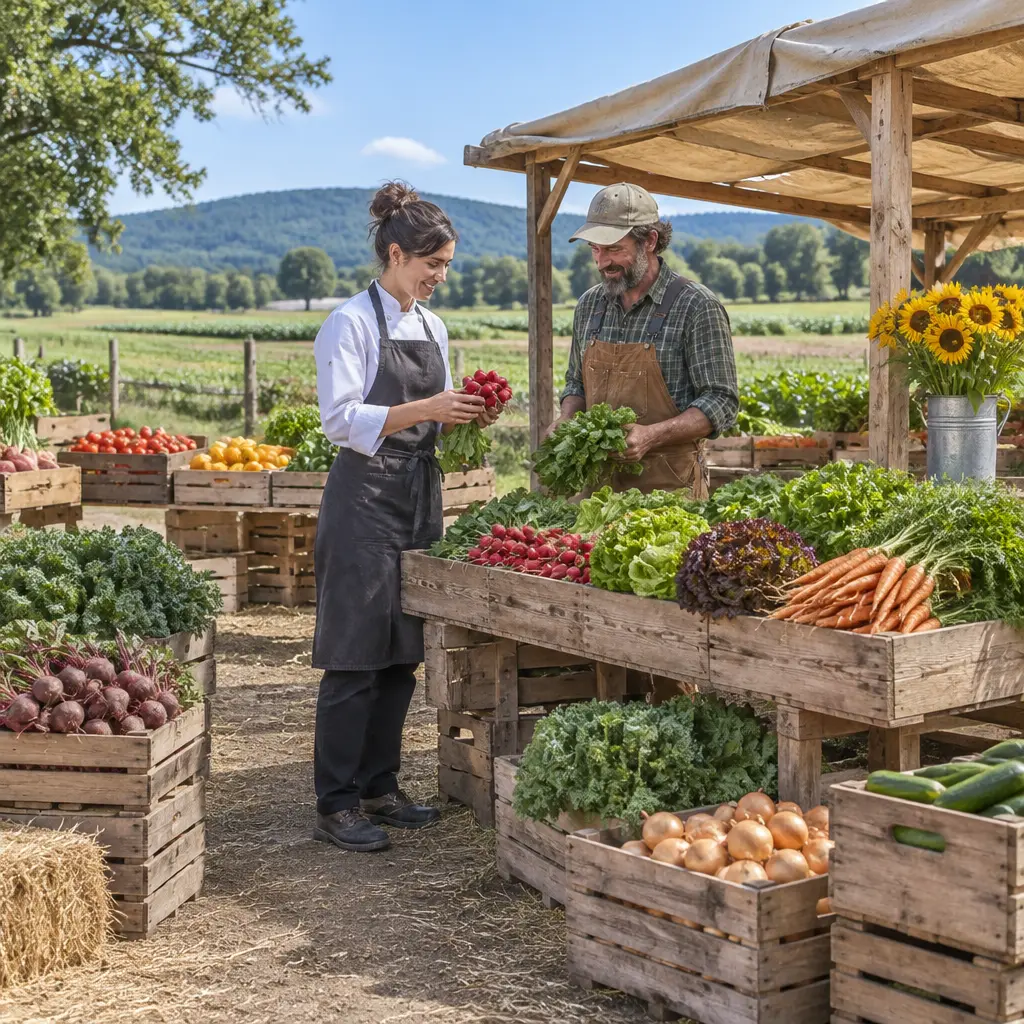
Small-producer sourcing is the practice of buying food directly or through short supply chains from independent farms, ranches, fisheries, and makers. Chefs look beyond flavor: they assess consistency, safety, availability, price, delivery, and the producer’s ability to communicate and build a dependable relationship. The USDA’s 2022 Census of Agriculture counted about 1.9 million U.S. farms, while USDA local-food research describes direct marketing as one route connecting producers with consumers and food businesses. For chefs, the best sourcing decisions balance quality and provenance with the practical realities of a working kitchen.
Chefs define small-producer sourcing through quality, reliability, and fit
There is no single universal definition of a “small producer.” The term can refer to a farm or food business of modest scale, a locally based supplier, or a producer using independent or specialty production methods. The USDA’s Census of Agriculture classifies farms by measures including acreage, sales, and production; chefs generally use a more practical definition: a producer is “small” when the business is close enough, specialized enough, or independently run enough to offer a distinctive product and direct communication.
This makes sourcing a comparison of attributes rather than a simple preference for local food. Chefs consider sensory quality, dependable volume, food safety, price, traceability, and the effort required to place and receive orders. Those criteria are connected: a rare tomato may be exceptional, but it is only useful for a menu if its harvest window and quantity are clear.
Flavor, freshness, and product distinction
Product quality means how well an ingredient meets the restaurant’s culinary requirements. Chefs evaluate taste, aroma, texture, maturity, appearance, and performance in cooking—not merely whether a product looks attractive. A chef might seek a particular potato variety for roasting, a specific cut of meat for braising, or greens harvested young for a salad.
Small producers can offer varieties or cuts that larger distribution systems do not routinely carry, along with harvest timing that supports freshness. USDA Agricultural Marketing Service materials describe local and regional food systems as channels that can connect producers more directly with buyers. Directness does not guarantee superior quality, however; chefs still need samples, clear specifications, and consistent handling.
Reliability, volume, and seasonality
Reliability is a supplier’s ability to deliver the agreed product, quantity, and timing repeatedly. Small farms may experience weather-related variation or short harvests, so chefs often ask about weekly capacity, crop calendars, substitutions, and minimum orders before adding an ingredient to a menu.
Seasonality is both an opportunity and a constraint. A seasonal ingredient can shape a changing menu, but its limited availability requires planning. Chefs can reduce risk by using flexible menu language, identifying an approved substitute, and treating especially scarce products as specials rather than permanent menu fixtures.
Once a product fits the kitchen’s culinary and volume needs, the next question is whether the purchasing arrangement works in practice. That means evaluating safety, traceability, logistics, and the total cost of getting the product from producer to plate.
Chefs assess small-producer sourcing through safety and logistics
Food safety and logistics are the systems that protect an ingredient’s condition and make it usable after purchase. A chef’s evaluation commonly includes how food is harvested, cooled, packed, transported, labeled, and stored, as well as how quickly the supplier can respond to a problem.
Food safety and traceability
Traceability is the ability to identify where a product came from and follow its movement through the supply chain. Chefs may ask for product labels, harvest or packing dates, lot information, handling instructions, and records relevant to the food. These details help restaurants receive products safely and respond efficiently if a quality or safety issue arises.
The FDA’s Food Safety Modernization Act Produce Safety Rule establishes science-based standards for covered produce operations, with certain exemptions and modified requirements. Requirements vary by operation and product, so chefs should confirm applicable obligations rather than assume that a small farm is either exempt from every rule or subject to every provision. Restaurants also retain responsibility for safe receiving, storage, preparation, and service under applicable food codes.
Ordering, delivery, and communication
Logistical fit includes order deadlines, delivery days, packaging, minimum quantities, payment terms, and who handles delivery. A farm may produce excellent food but be unable to meet a restaurant’s receiving schedule. Chefs therefore clarify the ordering process early and agree on how changes, delays, and substitutions will be communicated.
Food hubs and distributors can help bridge this gap by aggregating products from multiple farms, coordinating orders, and consolidating deliveries. USDA research on local food marketing recognizes intermediated channels alongside direct-to-consumer sales. For restaurants, an intermediary may reduce administrative and delivery burdens, though it can also add fees or limit direct contact with the producer.
Price, yield, and total value
Price is the invoice amount; value is what the kitchen receives after accounting for usable yield, labor, quality, and waste. A higher-priced whole product may be economical if it arrives clean and uniform, while a lower-priced item may cost more in trimming, spoilage, or inconsistent results. Chefs compare products on a usable-cost basis and consider whether the ingredient supports a menu price guests will accept.
The National Restaurant Association’s annual industry research documents the cost pressures facing restaurants, including food and labor expenses. That context makes transparent pricing important: producers should communicate price changes, pack sizes, and seasonal availability clearly, while chefs should share realistic forecasts and avoid treating a small supplier as a source of unlimited last-minute inventory.
With safety and operations established, chefs can decide whether a supplier’s production practices and local connection meaningfully support the restaurant’s values. Those claims matter most when they are specific and verifiable.
Chefs compare small-producer sourcing through provenance and partnership
Provenance is the documented origin and production history of food. For chefs, it can include the farm or fishery, variety or breed, production method, harvest date, and route to the restaurant. Partnership describes the ongoing working relationship through which chefs and producers coordinate product specifications, forecasts, and feedback.
Production practices and claims
Chefs may ask about soil management, pesticide practices, animal care, feed, fishing methods, or processing. These questions help them understand how a product is made, but broad terms such as “sustainable,” “natural,” and “regenerative” can mean different things unless the producer explains the practice and its evidence. Organic claims, by contrast, are governed by USDA National Organic Program standards when a product is represented as certified organic, subject to the program’s rules and exceptions.
A responsible buyer distinguishes a producer’s stated practices from third-party certification and avoids making claims on a menu that cannot be substantiated. Specific descriptions—such as naming the farm, variety, or harvest method—are generally more informative than unsupported environmental superlatives.
Communication and mutual planning
A strong supplier relationship depends on timely, two-way communication. Chefs can share anticipated demand, preferred sizes, acceptable substitutions, and feedback on quality. Producers can share crop forecasts, shortfalls, price changes, and harvest windows. This exchange helps both parties plan labor and inventory rather than relying on emergency orders.
For example, a restaurant planning a summer menu around local stone fruit can ask a grower about expected varieties and harvest timing before printing the menu. The grower can reserve an agreed quantity or flag a weather-related risk; the chef can keep a second dessert or preserve option ready. The example illustrates why a dependable relationship is not simply friendliness: it is a practical method for managing supply uncertainty.
Local purchasing and community impact
Local purchasing can keep more buying relationships within a region and give chefs a clearer connection to the people producing their ingredients. USDA Economic Research Service publications on local food systems examine direct and intermediated marketing channels, but “local” does not have one nationally fixed mileage definition for every food program or buyer. Restaurants should state what local means in their own purchasing policy and verify the origin of products they describe that way.
Small-producer sourcing is not automatically cheaper, more sustainable, or more equitable than conventional sourcing. Its broader value depends on the actual product, production practices, distribution route, and terms of trade. Clear expectations and fair payment can make the relationship more durable for both the restaurant and the producer.
Chefs turn sourcing criteria into a repeatable process
A structured process helps a kitchen assess suppliers consistently instead of relying on impressions. Chefs can start with a product trial, confirm operational details, and then review performance after delivery.
- Define the product: specify variety, grade or size, quantity, pack format, and intended use.
- Ask about availability: request a seasonal calendar, expected weekly volume, minimum order, and substitution policy.
- Check handling and documentation: discuss cooling, transport, labeling, traceability, and applicable safety requirements.
- Test the product: evaluate flavor, usable yield, consistency, and performance in the actual recipe.
- Agree on commercial terms: confirm pricing, delivery schedule, payment timing, and procedures for shortages or quality concerns.
- Review the relationship: track fulfillment, quality, waste, communication, and value over time.
A simple supplier scorecard can compare sensory quality, consistency, safety documentation, delivery performance, price, communication, and provenance. The scorecard should support judgment, not replace it: a chef may accept a seasonal fluctuation from a valued farm while choosing a more standardized supplier for a high-volume staple.
Conclusion: Chefs source from small producers for fit, not scale alone
Chefs evaluate small producers through a connected set of attributes: flavor and distinctiveness, reliable supply, food safety and traceability, workable delivery, total value, credible production information, and clear communication. Small scale can create opportunities for distinctive ingredients and direct relationships, but it does not remove the need for documentation, planning, and consistent standards.
For restaurants, the practical next step is to define purchasing specifications, trial products, and build flexible seasonal menus around realistic supply. For producers, clear availability updates, transparent pricing, and straightforward handling information help chefs make confident commitments. Together, these practices can strengthen regional food connections while keeping the kitchen dependable and financially viable.
Sources: USDA National Agricultural Statistics Service, 2022 Census of Agriculture, https://www.nass.usda.gov/Publications/AgCensus/2022/; USDA Agricultural Marketing Service, Local Food Directories and Data, https://www.ams.usda.gov/services/local-regional/food-directories; U.S. Food and Drug Administration, FSMA Final Rule on Produce Safety, https://www.fda.gov/food/food-safety-modernization-act-fsma/fsma-final-rule-produce-safety; USDA Agricultural Marketing Service, National Organic Program, https://www.ams.usda.gov/about-ams/programs-offices/national-organic-program; USDA Economic Research Service, Local Food Systems: Concepts, Impacts, and Issues, https://www.ers.usda.gov/publications/pub-details/?pubid=46393; National Restaurant Association, Research and Reports, https://restaurant.org/research-and-media/research/.