
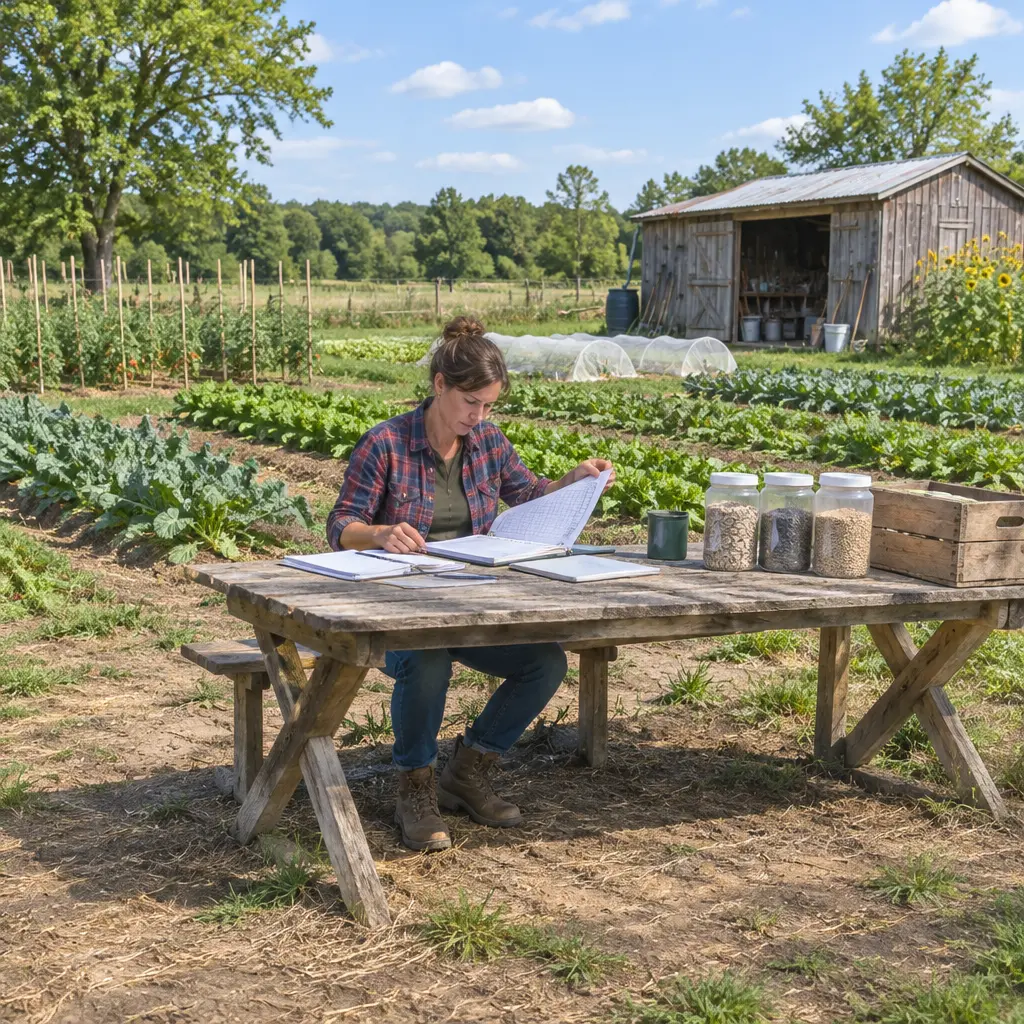
Organic certification is a regulated verification process that lets a farm sell products as “organic” under the U.S. Department of Agriculture’s National Organic Program (NOP). For a small farm, the real cost is more than the certification fee: it can include inspection, recordkeeping, approved inputs, changes to production and handling, and the time needed to manage compliance. USDA data show that certification fees can be reimbursed through the Organic Certification Cost Share Program, but reimbursement does not erase the paperwork, cash-flow demands, or transition costs. Whether certification pays depends on the farm’s products, buyers, acreage, labor, and ability to capture an organic premium.
What USDA organic certification costs a small farm
The National Organic Program defines the standards behind the USDA organic label. USDA-accredited certifying agents assess whether an operation follows those standards, including its production practices, records, and handling procedures. Certification is therefore both a direct expense and an ongoing management obligation—not simply a one-time application fee.
There is no single national price. Certifiers set their own fees, and the total varies with the operation’s size, complexity, location, products, and whether it farms, processes, or handles goods. A small diversified farm may have several crop types, harvest windows, and suppliers to document, while a single-crop operation may have a simpler system.
Application, inspection, and annual certification fees
A farm typically pays an application or review fee, an annual certification fee, and inspection-related charges. Inspections may involve travel or additional time when the operation has multiple sites or complex activities. The certifier’s current fee schedule is the best source for a farm-specific estimate; ask for a written estimate covering the first year and annual renewals.
USDA’s Organic Certification Cost Share Program can reimburse eligible operations for part of qualifying certification expenses, subject to program rules and funding. The maximum reimbursement and eligible expense categories can change, so farmers should confirm current limits with their state agency or USDA before budgeting. Reimbursement reduces the net cost, but the farm may need to pay the bill first and submit documentation afterward.
Recordkeeping and staff time
Certification requires records that demonstrate compliance and allow products to be traced from inputs through harvest and sale. Depending on the operation, this can include seed and input purchases, field histories, planting and harvest records, cleaning logs, sales records, and measures to prevent commingling with nonorganic products.
The hours required are easy to overlook because they may not appear on a certifier’s invoice. A farmer or employee must prepare the organic system plan, keep records current, answer inspection questions, and report relevant changes. For a small farm with limited administrative capacity, those hours have an opportunity cost: time spent on compliance cannot be spent on production, marketing, or rest.
Inputs, infrastructure, and operational changes
Organic rules restrict many synthetic substances and require that permitted inputs meet applicable standards. A farm may need to replace familiar products with approved alternatives, strengthen weed or pest management, adjust fertility practices, or improve equipment cleaning and storage. Not every farm needs new infrastructure, but separate storage, clear labeling, buffer practices, or dedicated tools can add costs where contamination or commingling risks exist.
These costs depend on the starting point. A farm already using practices compatible with organic production may face mostly documentation and certification expenses. A farm that relies on prohibited materials or needs significant system changes may face a much larger transition bill.
How the organic transition affects a small farm’s finances
Certification is not immediate. Under USDA rules, land generally must be managed without prohibited substances for 36 months before crops harvested from it can be sold as organic. During that transition, a farm may incur new production costs without yet receiving the price or market access associated with certified-organic sales.
The three-year land transition
The transition period is a key source of financial exposure. A farmer may begin changing practices and keeping detailed records well before the first eligible organic harvest, while still selling the crop without an organic claim. The USDA’s Organic Integrity Database and the farm’s certifier can help clarify land eligibility and the relevant history for each field.
A transition budget should separate one-time costs from recurring costs. It should also account for possible yield changes, different labor needs, input substitutions, and the timing of sales. No single yield effect applies to all farms: outcomes vary by crop, soil, pest pressure, management skill, weather, and the length of time the system has been changing.
Yield, labor, and crop-protection trade-offs
Organic production may require more mechanical cultivation, hand weeding, crop rotation, scouting, or other preventive management. These approaches can add labor and equipment costs, though they may also improve soil management or reduce dependence on certain purchased inputs. A farm should model its own labor and yield assumptions rather than relying on a generalized claim that organic production always costs more or produces less.
The USDA Economic Research Service’s organic agriculture research emphasizes that organic outcomes differ across commodities and production systems. For a small farm, the practical question is whether the expected revenue and market access justify the specific changes needed on its fields—not whether organic production is categorically more profitable.
Certification exemptions and scale-sensitive options
Some operations that sell less than $5,000 in organic agricultural products annually are exempt from certification under federal rules, but they must still follow applicable organic production and handling requirements. Exempt operations cannot use the USDA organic seal and must not represent products as certified organic. Because the exemption is limited and has specific conditions, farms should confirm their status with USDA or a certifier before making label claims.
This distinction matters for very small direct-market farms. An exemption may avoid certification fees, but it does not provide the same verified status that some wholesale buyers, institutions, or consumers require. Certification can therefore be a market-access decision as much as a production decision.
When organic certification can pay for itself
Certification is most financially attractive when a farm can reliably sell enough product through channels that value the verified claim. A premium is not guaranteed: it varies by product, region, season, buyer, and competition. The farm should compare likely organic revenue with the full cost of certification and production changes, not simply compare a retail organic price with a conventional price.
Market access and buyer requirements
Some grocery, food-service, wholesale, and institutional buyers require certification to purchase or market a product as organic. Certification can open those channels, while direct sales may depend more on local customer relationships. Before applying, ask prospective buyers whether they require certification, what documentation they expect, how much volume they can take, and whether they offer a price premium or contract.
USDA’s annual Organic Survey provides national information on certified farms, sales, and production, illustrating that organic agriculture is a substantial U.S. market. National growth, however, does not guarantee a profitable outlet for any particular small farm. Local demand and buyer commitments are more useful than broad market headlines when making a farm-level decision.
A break-even calculation for the farm
A practical break-even estimate compares expected additional net revenue with certification and transition costs. Include fees, inspection charges, recordkeeping hours, approved inputs, extra labor, equipment changes, possible yield differences, and the cost of carrying expenses before organic sales begin. Subtract any eligible cost-share reimbursement only after confirming the current program rules and timing.
- Estimate certified-organic sales by crop and sales channel, using realistic volume and prices rather than best-case assumptions.
- Request written fee estimates from at least two USDA-accredited certifiers, if available for the farm’s location and products.
- Ask buyers for specific volume, quality, certification, and delivery requirements before committing to transition.
- Track owner and employee time as a real cost, even if no separate paycheck is issued for that work.
- Run a downside scenario with lower yields, delayed buyer demand, or no meaningful premium.
A small-farm example
Consider a diversified vegetable farm that sells through a farmers market and a local grocer. The market’s customers may value its growing practices, but the grocer may require USDA certification before labeling products organic. In this case, the farm should compare the expected wholesale volume and price with the cost of certification, extra records, and any changes to harvest handling. If the grocer offers only occasional purchases, certification may not recover its cost; if it commits to regular orders, the same expense may support a viable new channel.
This example is illustrative, not a forecast. The farm’s own sales records, labor rates, crop budgets, and buyer commitments should drive the decision.
A practical decision process for small farms
A useful decision starts with eligibility and demand, then tests operational readiness and cash flow. The goal is to determine whether certification supports a durable business strategy, not merely whether the farm can complete the application.
- Confirm field histories and the transition timeline with a USDA-accredited certifier.
- Identify the exact products and sales channels that would benefit from certified status.
- Build a first-year and recurring-cost budget, including labor and transition-period revenue.
- Check cost-share availability, deadlines, and reimbursement procedures with the appropriate state agency or USDA program contact.
- Set up a recordkeeping system before the first inspection and assign responsibility for maintaining it.
- Review the decision annually as buyer demand, farm capacity, and costs change.
Conclusion: the real cost is both financial and operational
The cost of going certified organic includes certifier and inspection fees, recordkeeping time, production adjustments, and the financial risk of a three-year land transition. USDA cost-share assistance may lower eligible certification expenses, and certification can create access to buyers that require verified organic status. But neither reimbursement nor a potential price premium makes certification automatically profitable.
Small farms should obtain current certifier quotes, verify transition eligibility, talk with buyers, and build a conservative break-even budget before committing. For additional guidance, consult the USDA National Organic Program, the Organic Certification Cost Share Program, and a local extension or sustainable-agriculture organization.
Sources: USDA Agricultural Marketing Service, National Organic Program, https://www.ams.usda.gov/about-ams/programs-offices/national-organic-program; Electronic Code of Federal Regulations, 7 CFR Part 205—National Organic Program, https://www.ecfr.gov/current/title-7/subtitle-B/chapter-I/subchapter-M/part-205; USDA Farm Service Agency, Organic Certification Cost Share Program, https://www.fsa.usda.gov/resources/programs/organic-certification-cost-share-program; USDA Agricultural Marketing Service, Organic Integrity Database, https://organic.ams.usda.gov/Integrity/; USDA National Agricultural Statistics Service, 2021 Organic Survey, https://www.nass.usda.gov/Publications/AgCensus/2022/Online_Resources/Organics/; USDA Economic Research Service, Organic Agriculture, https://www.ers.usda.gov/topics/natural-resources-environment/organic-agriculture/.